Improving wildlife links and biodiversity
We aim to minimise our scheme's impact on wildlife during construction and enhance biodiversity when it's finished.

We're not just creating a vital transport link in the Cotswolds. We're using world-class environmental practices to enhance surrounding landscape and habitats. Improvements include:
Trees shrubs and grassland
We'll plant 130,000 trees and shrubs across the scheme by the time it's finished. Working with our contractor Kier, we planted 17,000 trees in 2025.
We're planting native species that blend with the Cotswolds landscape, including oak, holly, field maple, hawthorn and yew.
Planting will screen the road from the surrounding area and replace trees removed during construction.
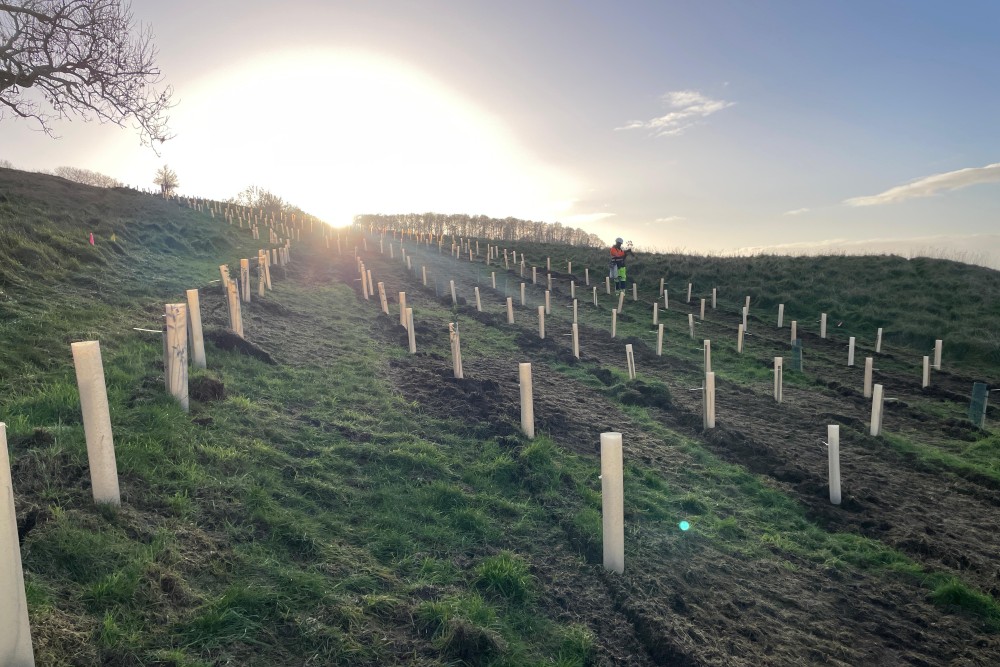
We've also introduced a five-year maintenance period for all trees and vegetation on our new schemes. This gives every tree the best chance of survival.
We'll also
- create over 80 hectares of new chalk grasslands across the scheme
- plant hedgerows
- create habitats for animals, birds and plant life.
We're trialling the use of biochar in tree planting. We'll plant 28 trees of different species in biochar to see how it affects their health and growth. If successful, we plan to use biochar across our planting programme.
Animal Translocation
We've safely relocated over 2,000 reptiles during construction including:
- Adders
- lizards
- Slow Worms
- Grass Snakes
Tracking Adders
We're collecting data on all of the reptiles, particularly Adders. We're recording sex, scale patterns, weight, and breeding condition.
In 2023, we fitted 10 Adders with radio tags so we could monitor their movements.
We tracked the Adders until they naturally shed the tags. This gave us valuable insights into their individual movement patterns during the breeding season.
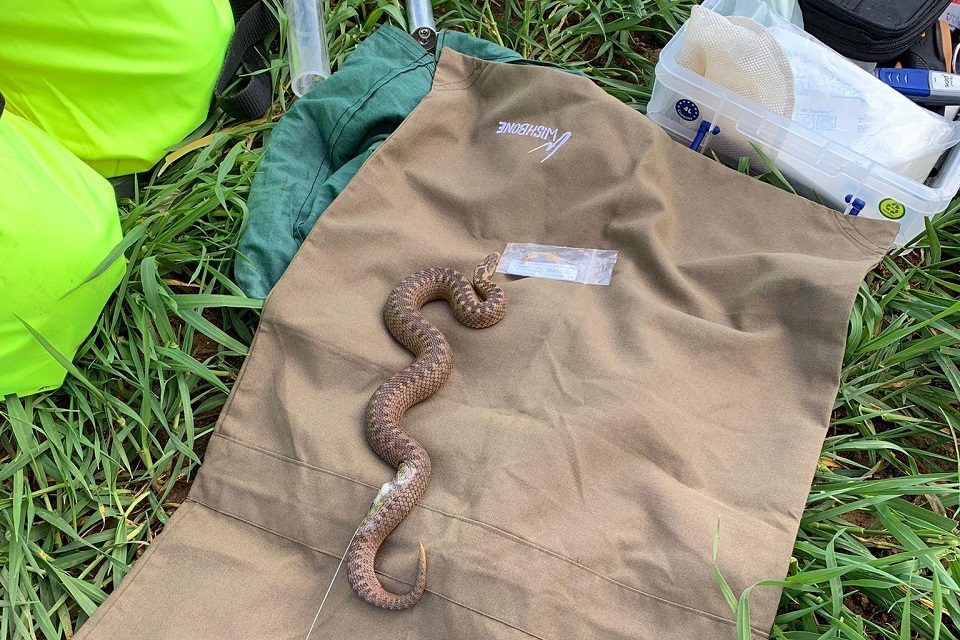
We found that released adult Adders first remained close to the release site. After breeding, many dispersed between 100 and 300 meters. It's encouraging that we found newborn Adders at all sites later in 2023 and into 2024.
Some Adders have travelled beyond their initial release areas. This suggests we need broader surveys to identify the habitats they've moved to.
Over the next five to 10 years, we expect to get a clearer and more accurate picture of population survival and expansion.
Encouraging bats
Some of the bat species along the A417 Missing Link and surrounding landscape include:
- Noctules
- Barbastelles
- Soprano and Common Pipistrelles
- Brown Long Eared bats
- Serotine and Natterers
To provide homes for them, we're:
- adapting structures, including a converted World War II bunker
- installing bat boxes
- using veteranisation techniques on mature trees
An on-site team of ecologists has supported us and supervised our work.
Dual use crossings
Wildlife and people will cross the main road by the fully planted Gloucestershire Way Crossing and two partially planted crossings.
Landscape and acoustic bunding
Extensive bunding (earth mounds) will reduce the impact of noise impact and help the road blend into the landscape.
Drystone Walling
We're building 7.5km of drystone walling. in keeping with surrounding Cotswold landscape. Gaps in drystone walling also provide homes for animals.
