Safety
Overview
The evaluation summarises how road safety changed during the first three years after the A500 Etruria Widening project opened. It compares safety performance before and after the project to assess whether it has improved conditions for road users and achieved its intended objectives.
The safety objectives were to:
- remove the collision hotspot associated with vehicles merging from the Porthill slip road onto the A500 southbound and exiting the A500 northbound to Porthill
- reduce the number and severity of personal injury collisions (PICs)
- maintain or reduce the number and severity of Fatal and Weighted Injury (FWI) casualties
Has the project achieved its safety objectives?
The evaluation has demonstrated that the project has achieved its safety objectives. During the first three years after opening, both the number of personal injury collisions and overall collision rates reduced. No fatal or serious collisions were recorded on the project extent during the evaluation period.
What impact did the project have on collisions?
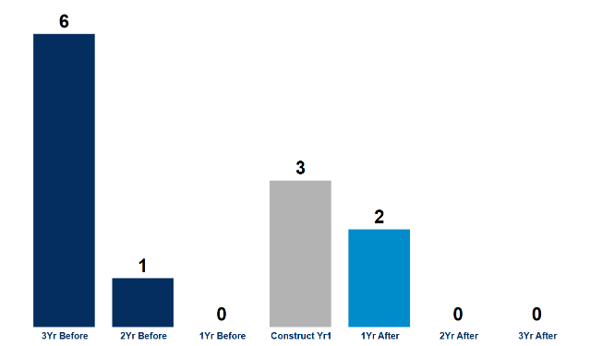
In the three-year period before the project opened there were seven collisions, an average number of just over two per year. This reduced to an average of just under one per year for the three-year period after the project opened. The figure below shows changes in the number of personal injury collisions before the project, during construction and after opening.
Number of personal injury collisions before the project, during construction, and after the project opened.
What impact did the project have on collision rates?
Collision rates reduced from 13.3 personal injury collisions per hundred million vehicle miles (hmvm) before opening to zero during the three-year evaluation period.
Has the project contributed to these changes?
The project was designed to remove the collision hotspot associated with vehicles merging onto and exiting the A500 at Porthill. Following project opening, both collision numbers and collision rates reduced, suggesting the project has contributed to improved safety at this location.
The relatively small number of collisions recorded on the project extent means however that counterfactual analysis could not be undertaken.
What impact did the project have on collision severity?
The evaluation found a reduction in collision severity, and no fatal or serious injury collisions were recorded before opening or during the evaluation period.
Number of personal injury collisions by severity
| Severity | Before | After | Observed change |
|---|---|---|---|
| Fatal (total) | 0 | 0 | 0 |
| Serious (per year) | 0 | 0 | 0 |
| Slight (per year) | 2.33 | 0.67 | -1.66 |
What impact did the project have on killed or seriously injured casualties?
The impact on casualty severity is measured using the number of killed or seriously injured casualties (KSI) and fatal weighted injuries (FWI).
The number of KSI casualties stayed neutral from an average of 0 before the project opened to 0 after opening. The KSI rate also remained neutral from an average of 0 per hundred million vehicle miles (hmvm) to 0.
FWI reduced from an average of 0.03 before opening to 0.01 after opening. The FWI rate also reduced from an average of 0.27 per hmvm to 0.01.
Overall, these findings suggest the project is having a positive impact on the severity of casualties within the project extent.
Change in KSI and FWI
| Metric | Before | After | Observed change |
|---|---|---|---|
| Killed or Seriously Injured | 0 | 0 | 0 |
| Killed or Seriously Injured Rate (hmvm) | 0 | 0 | 0 |
| Fatal Weighted Injury | 0.03 | 0.01 | 0.02 |
| Fatal Weighted Injury Rate (hmvm) | 0.27 | 0.1 | -0.17 |
What impact has the project had on the wider safety area?
We observed a reduction in PICs across the wider safety area, with the number of collisions falling from 184 to 66. The collision rate also reduced from 25.6 to 11.1 PICs per hmvm. Reductions were observed across all collision severities and KSI, FWI casualties. We also compared the results with what would have been expected without the project. This suggests the reduction in collision rates is greater than what would be expected from wider road safety trends alone, indicating the project is helping to improve safety.
