Government greenlights record breaking Lower Thames Crossing tunnelling machine
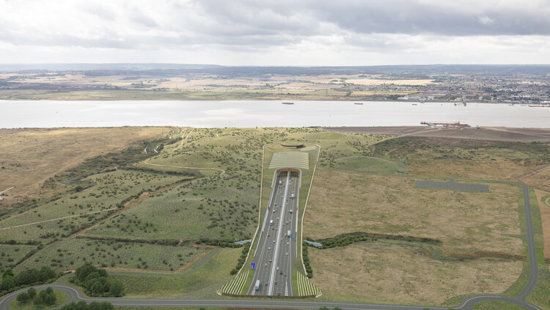
Momentum is growing on National Highways' Lower Thames Crossing, with the process of buying one of the world's largest tunneling machines now under way – just days after funding for the scheme was announced in the budget.
In a significant milestone for the project, it is setting its sights on a machine capable of digging through the complex ground conditions 60 metres below the Thames.
It comes after the Chancellor of the Exchequer last week committed £891m of investment into the road connecting Kent and Essex.
The Rt Hon Rachel Reeves MP described the scheme as an example of infrastructure “that is the backbone of economic growth across our country”.
The financial support from the Government means work can start next year and enable the project to harness billions of pounds of private sector investment to deliver the remainder of the construction.
Following last week’s announcement, the scheme’s tunneling partner Bouygues Travaux Publics Murphy Joint Venture is now inviting tenders from prospective suppliers who could build the tunnel boring machine.
Delivered by National Highways, the Lower Thames Crossing will be the first major infrastructure project to be carbon neutral in construction.
It is taking a low-carbon approach that only requires one machine to dig both the north and southbound tunnels, which also keeps costs down while not adding additional time to construction.
The 16.4 metres wide tunnel boring machine will excavate one of the widest tunnels in the world, allowing three lanes of traffic in each direction and doubling road capacity across the Thames east of London. More than 4 kilometres in length, it will be the longest road tunnel in the UK.
The machine is expected to be purchased next year before digging begins in 2028. Next summer, work on the northern tunnel entrance where the tunnel machine will begin its journey will get under way.
The 110 metre long, 26 metre deep structure will be built within a new worksite that will include the temporary factory that will produce the concrete segments needed to line the tunnel. The structure will eventually be hidden underneath a new landscaped park overlooking the Thames near Tilbury docks, called Tilbury Fields.
Roads and Buses Minister Simon Lightwood said: "The launch of the procurement process for Europe's largest tunnelling machine marks a major step forward for this transformational project, backed by £891 million in the Budget which demonstrates this Government's determination to deliver the infrastructure our economy needs to grow.
"By unlocking vital capacity across the Thames, the Lower Thames Crossing will relieve congestion at Dartford and create better connections between our ports, manufacturing centres and communities, but also be a key driver of jobs, growth and opportunity."
Matt Palmer, Executive Director of the Lower Thames Crossing said: "The search for our giant tunnel boring machine is now on, putting us on track to open the Lower Thames Crossing in the early 2030s.
"We’re a step closer to delivering this vital piece of infrastructure, that will improve the journeys for millions and drive growth by creating jobs and new opportunities for business and trade."
The project has already started preparatory work along the route of the new road, including ecological and archaeological surveys, utility diversions, and creation of new habitats for local wildlife.
The Lower Thames Crossing will be Britain’s greenest road. Two new public parks will be created by using material excavated from the tunnel, keeping over 470,000 lorries off local roads and saving millions of tonnes of carbon.
The project will leave behind six times more green space than road, with almost 40 miles of new or improved pathways for walkers, cyclists and horse riders. A new community woodland, Hole Farm, near Brentwood, Essex will open next year, along with a new wetland for migratory birds on the banks of the Thames.
In total, around 80% of the scheme will be underground or behind a cutting or embankment, minimising visual and noise impact for local people, and protecting habitats for wildlife.
The project will tackle congestion at Dartford and drive growth by creating a new connection between the ports of the southeast, the Midlands and the north. The project received planning permission in March 2025.
The new road is expected to open in the early 2030s.
Notes to Editors
National Highways is the wholly government-owned company responsible for modernising, maintaining and operating England’s motorways and major A roads.
Real-time traffic information for England’s motorways and major A roads is available via the Traffic England website, local and national radio travel bulletins, electronic road signs and mobile apps. Local Twitter services are also available.
For further information please contact National Highways' press office (24hrs) on 0844 693 1448 and select the most appropriate option:
Option 1: National enquiries (9am to 5.30pm) and out of hours for urgent enquiriesOption 2: North West (9am to 5.30pm)Option 3: Yorkshire and North East (9am to 5.30pm)Option 4: West Midlands (9am to 5.30pm)Option 5: East Midlands (9am to 5.30pm)Option 6: East (9am to 5.30pm)Option 7: South East (9am to 5.30pm)Option 8: South West (9am to 5.30pm)
