Innovation to implementation guide
2026-2027
Contents
Who this guide is for
This guide covers the full innovation to implementation journey at National Highways. It’s flexible for different stakeholders and innovation types, supporting both experts and non-specialists throughout their journey. By drawing on established standards and real-world experience, it will help you confidently progress through each phase of the innovation journey, right up to successful implementation.
The guide is maintained as a living resource which is reviewed and updated periodically, ensuring content aligns with evolving requirements. This approach enables users to apply these insights to their own projects while navigating common implementation challenges.
Please use our contact form if you have feedback about this guide.
How to use this guide
This guide is structured to support you throughout the entire innovation to implementation journey. Begin by familiarising yourself with the five-stage journey, principles and glossary of terms, which provide a common language for all stakeholders.
Find out more on the five-stage innovation to implementation journey
For each stage, review the three key steps:
- What to achieve
- Who needs to be involved
- What needs to be done
The Innovation team can support you and position you on this journey with the innovation scorecard
The guide acts as a navigator and enables you to take an informed approach to innovation with us. See the scenario boxes for insights and considerations drawn from real-world cases. It will be updated periodically, so make sure to revisit the page for the latest practices and innovations. Feedback and sharing of good practice are encouraged to ensure this guidance remains current.
Definitions
The following definitions are used in this document:
Innovation – Transforms insights, ideas and newly created knowledge into value by developing, testing and refining them, managing risks, and embedding meaningful and lasting change to deliver benefit.
Innovation implementation – Innovation becomes business as usual with standards adopted that mandate innovation at scale, ensuring implementations deliver sustained value through proper adoption, monitoring and refinement.
Directorates
You may work with the following National Highways directorates as part of your innovation to implementation journey:
Major Projects – Responsible for significant projects and major enhancements to the strategic road network. Also seeks opportunities for sustainable travel and helping nature to thrive, and supports the journey to net zero carbon.
Operations – Plans and delivers all maintenance activities, and drive efficiencies and improvements across our systems and roads. Also helps deliver programmes to provide environmental, social and economic benefits.
Safety, Engineering and Standards – Provides the technical expertise to build and operate our roads safely and efficiently. Assists the delivery of projects under four areas - standards, advice, assurance and change - enabling and delivering innovation..
Customer, Strategy and Communications – Provides corporate strategic planning for the organisation. Delivers critical analytical support, provides strategic direction for customer services, partners with colleagues across the business to devise and deliver communications.
Digital Services – Focuses on developing digital, data and technological solutions, and creating joined-up platforms, products and services across the organisation.
Business Services – Focuses on delivery of National Highways’ plans and goals, through collaboration with other parts of the organisation.
The guiding principles
These principles establish the values and practices for this guide, ensuring it remains practical and flexible throughout the innovation to implementation journey.
Journey-led, with the right people involved – It offers a clear and practical understanding of the innovation to implementation journey within National Highways. This approach applies broadly and remains agnostic to varying funding structures and links with existing and evolving internal procedures.
Iterative progression – The guide adapts to differing requirements at each stage of the innovation journey and supports transparency through clarity of how innovation progresses across each stage.
Standard inspired and practice-informed approach – The guide takes inspiration from standards like ISO56000 and is based on practical real-world experience, supporting the full innovation cycle. This enables ongoing stakeholder mapping and prioritisation at each stage of the journey.
Balanced focus – Equal attention is given to National Highways standards, procurement, innovation and integration with operations.
Engagement, relationship building and communication – Fostering strong connections between stakeholders, partners and colleagues is vital for collaboration and successful innovation. This approach helps people understand initiative benefits and supports assessment throughout the process, ensuring feasibility, sustainability and inclusivity.
Governance, decision-making and transition points – Clear roles and responsibilities inform governance and decision-making at every stage. They include sponsors, challenge owners, risk and solution owners and change managers. This helps teams engage the right stakeholders at the right time to ensure effective governance.
Full journey overview
The full innovation journey outlines our approach to innovation, from concept creation through to full-scale implementation.
It focuses on five stages which build meaningful relationships and create good organisational conditions for successful innovation, embedding this in the wider context with National Highways challenges.
Stage 1 - Create concepts
Opportunities are developed into early-stage concepts, forming structured initiatives designed to explore potential solutions.
1 What is this stage achieving?
At this stage, understand and consider the whole process and all stakeholders from the start.
This stage focuses on defining the innovation potential and is strongly research oriented.
A theoretical understanding is developed to recognise whether there is a need and business case for the innovation. Initial conversations across and outside of the organisation are conducted to establish a network of collaborative stakeholders.
These relationships are key to gather detail further on in the process, enable trial opportunities, and allow for the sharing of learnings with regards to the solution and the journey.
With an effective stakeholder network in place, the process can progress with the highest chance of successful implementation.
2 Who needs to be involved and relevant processes
| Who needs to be involved | Processes / people to engage with |
|---|---|
| Health, Safety and Wellbeing team – to ensure adherence to GG104 requirements, etc. | Management Arrangements for Safety Risk and requirements, including GG104 |
| Technical specialists and subject matter experts – for trial advice, departures / amendments to standards and understanding the evidence needed to prove technical feasibility and scalability of the solution. |
Relevant technical partners |
| Major Projects – to understand cost, timescale and capacity implications of possible trials being run as part of a scheme. | Major Projects Sponsorship team |
| Operations – to understand cost, timescale and capacity implications of possible trials being run as part of a scheme. |
Planning and Development team (region specific) Change managers (region specific) |
| Business Planning team – to access operations sites (national view) for trials. | Strategic Asset Investment Planning |
| Industry and interest groups – to understand their work in this space, sector trends, and the opportunities and challenges they see for this kind of innovation. | Specific to each innovation initiative. |
| Commercial and Procurement, and Economics teams – to establish resources and validate commercial logic, understand potential value for money and supply-chain considerations. |
Commercial:
Procurement Economics |
| Digital Services – for everything on data, digital feasibility and technological requirements. | Digital Demand process |
| Customer, Strategy and Communications – if there is impact on customers or potential to change ways of working for National Highways staff, which could help to define future priorities. |
Customer team Business Improvement and Change team |
3 Review innovation scorecard
Confirm all criteria in the scorecard for this current stage has been achieved.
Aiming for future success: review the criteria in the scorecard for the next stage – Validate concept – and ensure a separate work package is included in the next phase of the project to address and answer these requirements, as this will unlock future phase funding (if applicable).
4 Key insights and considerations
Health, safety and wellbeing is of paramount importance to National Highways. As such, the GG 104 process is mandatory and must be adhered to throughout the lifecycle of the innovation initiative.
The Innovation Scorecard establishes key considerations that need to be addressed in the next stage. As such, it's mandatory to include a separate work package / deliverable in any procurement contract associated with the innovation at each stage of the innovation journey to address and answer the requirements.
Engagement with Digital Services is mandatory for any initiative with a digital element (including data, software, hardware, technology, etc).
Ideas frequently originate from the market research or supplier input, which can lead the team to concentrate on a single solution and limit broader thinking. While exploring options is valuable, it’s essential to return to a clear problem definition to make sure the aim is solving the actual problem.
The project team should be open to consulting with our supply chain at all levels, not only Tier 1 partners.
Poor early engagement with commercial and operations teams and suppliers can result in supply chain problems later.
Identify and validate potential scaling routes, including an assessment of key barriers and their impacts.
Stage 2 - Validate concepts
Concepts are tested on a small scale using appropriate tools and methods to validate assumptions and assess overall potential.
1 What is this stage achieving?
At this stage, theoretical concepts are transformed into proof-of-concept in collaboration with delivery teams.
It's essential to analyse Stage 1 (Create concepts) thoroughly and conduct trials to gather evidence on whether validation targets and the associated success criteria can be achieved. If it’s deemed that the targets and success criteria cannot be achieved as part of a trial, due consideration should be given as to whether the trial should proceed.
During trials, it's essential to assess the innovation's impact on current standards and procedures, using data-driven research to pinpoint areas where it adds genuine value.
Trialling may occur off-site, within regional Operations delivery schemes or within Major Projects. Discussion to identify appropriate sites and to allow sufficient time for trialling should be included in any collaboration with the site owner. Understanding industry buy-in at this stage is crucial to ensure the next phase of solution development meets market needs.
2 Who needs to be involved and relevant processes
| Who needs to be involved | Processes / people to engage with |
|---|---|
| Health, Safety and Wellbeing team – to ensure adherence to GG104 requirements, etc. | Management Arrangements for Safety Risk and requirements, including GG104 |
| Technical specialists and subject matter experts – for trial advice, departures / amendments to standards and understanding the evidence needed to prove technical feasibility and scalability of the solution. | Relevant technical partners |
| Major Projects – to understand cost, timescale, capacity and skills implications of possible trials being run as part of a scheme. Also to see whether a scheme can be operated and maintained at scale. | Major Projects Sponsorship team |
| Operations – to understand cost, timescale, capacity an skills implications of possible trials being run as part of a scheme. Also, to see whether a scheme can be operated and maintained at scale. |
Planning and Development team (region specific) Change managers (region specific) |
| Business Planning team – to access operations sites (national view) for trials. | Strategic Asset Investment Planning |
| Industry and interest groups – to assess the potential of the initiative and secure their support. Such engagement should clarify the anticipated demand and supply situation, as well as identify the material requirements and training needed to ensure successful implementation. | Specific to each innovation initiative |
| Commercial and Procurement, and Economics teams – to establish resources and validate commercial logic for procuring the initial demonstration, understanding the potential Value for Money and to see whether a solution can be operated and maintained at scale with the supply chain. |
Commercial:
Procurement Economics |
| Digital Services – for everything on data, digital feasibility and technological requirements. | Digital Demand process |
| Customer, Strategy and Communications – if there is impact on customers or potential to change ways of working for National Highways staff, which could help to define future priorities. Also to use communications mechanisms to raise awareness of the trial (regionally and nationally), to identify opportunity for wider rollout. |
Customer team Business Improvement and Change team Communications team |
3 Review innovation scorecard
Confirm all criteria in the scorecard for this current stage has been achieved.
Aiming for future success: review the criteria in the scorecard for the next stage – Develop solutions – and ensure a separate work package is included in the next phase of the project to address and answer these requirements, as this will unlock future phase funding (if applicable).
4 Key insights and considerations
Clearly identify health, safety and wellbeing, and ethics requirements and ensure that the Safety Risk Assessment is completed in line with GG 104, as this is mandatory. Map GG 104 requirements across stages to avoid duplication.
The Innovation Scorecard serves to establish key considerations that need to be addressed in the next stage. As such, it's mandatory to include a separate work package / deliverable in any procurement contract associated with the innovation at each stage of the innovation journey, to address and answer the requirements.
Engagement with Digital Services is mandatory for any initiative with a digital element (including data, software, hardware, technology, etc).
Engagement with the Business Improvement and Change team is mandatory for any initiative that may impact ways of working for National Highways staff.
Too little early engagement with commercial and operations teams and suppliers can result in supply chain problems later.
Clarity over responsibilities and ownership (of intervention and risk) and how these change over time, including for decommissioning of any trials, is essential for successful innovation to implementation (e.g. once a trial is completed who is responsible for implementation, who is responsible for decommissioning and upcycling the trial 'assets', etc.).
The project team should be open to consulting with our supply chain at all levels, not only Tier 1 partners.
Understanding industry buy-in at this stage is crucial to ensure the next phase of solution development meets market needs.
When carrying out on-site trials to validate success criteria, conversations and activities with delivery stakeholders should account for the path to business-as-usual.
Alongside gathering data on the set validation targets, the key focus here is to identify changes required in processes and systems, including for example the Departures from Standards process and possible changes to standards in future or the product approval process.
As per CDM practice, understand the wider required infrastructure that needs to be in place to operate and maintain the solution.
Implement a robust testing and feedback loop to validate concepts and allow National Highways and industry stakeholders to address their concerns to maintain their understanding and endorsement.
Assess how the trial will end. Sharing results is key in raising industry awareness and understanding how to move into the next stage.
There has historically been a lot of focus on the early stages of the innovation journey, the trial and validation. A greater focus on the post-trial journey, through planning (including in Stage 3 – Develop solution) will define the latter phases better and increase the chances for successful implementation.
Identify and validate potential scaling routes, including an assessment of key barriers and their impacts.
Stage 3 - Develop solution
Validated concepts are developed into robust solutions that can be deployed, marking the transition from concept (innovation initiative) to solution (change project).
1 What is this stage achieving?
In this stage, the focus is on planning how to implement the innovation. Setting a clear vision at this stage is essential for a successful outcome to lead to an optimised solution. Plan for and decide on the most appropriate approach to implement the innovation at scale.
Understand how the solution can be implemented within the existing operational environment, while ensuring it’s optimised for widescale rollout to maximise success and benefits, leading to implementation as business-as-usual.
There's a need to assess whether implementation is realistic and worth pursuing. If it’s deemed that the proof of concept will not deliver long-term value / return on investment, consideration should be given to conclude the initiative.
2 Who needs to be involved and relevant processes
| Who needs to be involved | Processes / people to engage with |
|---|---|
| Health, Safety and Wellbeing team – to ensure adherence to GG104 requirements, etc. | Management Arrangements for Safety Risk and requirements, including GG104 |
| Technical specialists and subject matter experts – for advice on wider rollout including additional trials, departures / amendments to standards and understanding the evidence needed to prove technical feasibility and scalability of the solution. |
Relevant technical partners |
| Major Projects – to understand cost, timescale, capacity and skills implications of wider rollout. Also, to see how a solution can be procured, operated and maintained at scale. | Major Projects Sponsorship team |
| Operations – to understand cost, timescale, capacity an skills implications of wider rollout. Also, to see how a solution can be procured, operated and maintained at scale. The regional change managers will be key to establishing this. |
Planning and Development team (region specific) Change managers (region specific) |
| Business Planning team – to access operations sites (national view) for trials and advice on wider rollout. | Strategic Asset Investment Planning |
| Industry and interest groups – to assess the potential of the initiative and secure their support. Such engagement should clarify the demand and supply situation, and risk ownership, as well as identify the material requirements and training needed to ensure successful implementation. | Specific to each innovation initiative. |
| Commercial and Procurement, and Economics teams – to establish resources and validate commercial logic for procuring any additional trials / initiative implementation. This should include an understanding of the risk ownership associated with implementation. Also, to understand any commercial blockers and the value for money, and to see how a solution can be operated and maintained at scale with the supply chain. Work with the Economics team to build an evidence‑based case demonstrating the project’s outcomes and cost‑effectiveness and clearly set out how it can be scaled to support wider long‑term goals. |
Commercial:
Procurement Economics |
| Digital Services – for everything on data, digital feasibility and technological requirements. | Digital Demand process |
| Customer, Strategy and Communications – if there is impact on customers or potential to change ways of working for National Highways staff, which could help to define future priorities. Also to use communications mechanisms to raise awareness of the initiative (regionally and nationally), to identify opportunity for implementation. |
Customer team Business Improvement and Change team Communications team |
3 Review innovation scorecard
Confirm all criteria in the scorecard for this current stage has been achieved.
Aiming for future success: review the criteria in the scorecard for the next stage – Deploy solution – and ensure a separate work package is included in the next phase of the project to address and answer these requirements, as this will unlock future phase funding (if applicable).
4 Key insights and considerations
Clearly identify health, safety and wellbeing, and ethics requirements and ensure that the Safety Risk Assessment is completed in line with GG 104, as this is mandatory. Map GG 104 requirements across stages to avoid duplication.
The Innovation Scorecard serves to establish key considerations that need to be addressed in the next stage. As such, it's mandatory to include a separate work package / deliverable in any procurement contract associated with the innovation, at each stage of the innovation journey to address and answer the requirements.
Engagement with Digital Services is mandatory for any initiative with a digital element (including data, software, hardware, technology, etc).
Engagement with the Business Improvement and Change team is mandatory for any initiative that may impact ways of working for National Highways staff.
Too little early engagement with commercial and operations teams and suppliers can result in supply chain problems later.
Clarity over responsibilities and ownership (of intervention and risk) and how these change over time, including for decommissioning of any trials, is essential for successful innovation to implementation (e.g. once a trial is completed, who is responsible for implementation, who is responsible for decommissioning and upcycling the trial 'assets', etc.).
The project team should be open to consulting with our supply chain at all levels, not only Tier 1 partners, and ensure early contractor involvement.
Understanding industry buy-in at this stage is crucial to ensure the next phase of solution development meets market needs.
When carrying out on-site trials to validate success criteria, conversations and activities with delivery stakeholders should account for the path to business-as-usual.
Alongside gathering data on the set validation targets, the key focus here is to identify changes required in processes and systems, including for example the Departures from Standards process and possible changes to standards in future or the product approval process.
As per CDM practice, understand the wider required infrastructure that needs to be in place to operate and maintain the solution.
Implement a robust testing and feedback loop to validate concepts and allow National Highways and industry stakeholders to address their concerns to maintain their understanding and endorsement.
Assess how any additional trials will end. Sharing results is key in raising industry awareness and understanding how to move into the next stage.
There has historically been a lot of focus on the early stages of the innovation journey, the trial and validation. A greater focus on the post-trial journey, through planning (including in Stage 3 – Develop solution) will define the latter phases better and increase the chances for successful implementation.
Effort at this stage is proportionate to required trial outcomes, ranging from a major live-site trial to a minor activity focused on implementation and communications planning, where the proof of concept is already comprehensive.
Contract mechanisms (including multi-year contracts) and how flexible they might be in commercially facilitating deployment of the new initiative, to ensure later implementation is successful.
The full lifecycle of the solution needs to be understood (i.e. if the supply of necessary materials and skills will continue to exist at scale and over time).
Identify and validate potential scaling routes, including an assessment of key barriers and their impacts.
Set realistic goals with stakeholders, partners and subject matter experts about the procurement process. Not all solutions will be adopted, and public procurement regulations must be adhered to.
Understand if an initiative is ready to scale. This can include aspects such as training, contract changes, product availability, resources and a supportive culture that enables network-wide implementation.
Stage 4 - Deploy solution
Solutions are transitioned into operational BAU and scaled across relevant users and customers to enable widespread adoption.
1 What is this stage achieving?
This stage implements the solution for long-term use, building on extensive prior testing and trialling, with operations and maintenance plans fully considered. Operations and maintenance insights from previous stages are actioned and reviewed in deployment (e.g. skills and training are being put in place).
Standards are either being prepared or in place, communicated and referenced in contracts to ensure safe operation and maintenance practices. Alternatively, a Departure from Standards could be used in the interim.
Associated benefits of the initiative will start to be realised. As the scaling of deployment increases, so will the return on investment.
2 Who needs to be involved and relevant processes
| Who needs to be involved | Processes / people to engage with |
|---|---|
| Health, Safety and Wellbeing team – to ensure adherence to GG104 requirements, etc. | Management Arrangements for Safety Risk and requirements, including GG104 |
| Technical specialists and subject matter experts – for advice on wider rollout, departures / amendments to standards and understanding the evidence needed to prove technical feasibility and scalability of the solution. |
Relevant technical partners |
| Major Projects – to understand cost, timescale, capacity and skills implications of wider rollout. Also, to see how a solution can be procured, operated and maintained at scale. Also to ensure adoption of the innovation, communicate at all levels (including supply chain quantity surveyors and designers) any changes in standards (e.g. DMRB / MCHW documents and implement required training – if applicable). | Major Projects Sponsorship team |
| Operations – to understand cost, timescale, capacity an skills implications of wider rollout. And to ensure a solution can be procured, operated and maintained at scale. Also to ensure adoption of the innovation, communicate at all levels (including supply chain quantity surveyors and designers) any changes in standards (e.g. DMRB / MCHW documents and implement required training – if applicable). The regional change managers will be key in establishing this. |
Planning and Development team (region specific) Change managers (region specific) |
| Business Planning team – to access operations sites (national view) for advice on wider rollout. | Strategic Asset Investment Planning |
| Industry and interest groups – to agree and secure their support. Such engagement should establish the demand and supply situation, risk ownership and identify the material requirements and training needed to ensure successful implementation. | Specific to each innovation initiative. |
| Commercial and Procurement, and Economics teams – to establish resources and validate commercial logic for long-term implementation. This should include an understanding of the risk ownership associated with implementation. Also to implement any commercial enablers and assure delivery of the value for money. |
Commercial:
Procurement Economics |
| Digital Services – for everything on data, digital feasibility and technological requirements. | Digital Demand process |
|
Customer, Strategy and Communications – if there is impact on customers or potential to change ways of working for National Highways staff, which could help to define future priorities. Also to use communications mechanisms to raise awareness of the initiative (regionally and nationally), to identify opportunity for implementation. Business improvement and change team - to support adoption through training and communications, ensuring handover from innovation to BAU. |
Customer team Business Improvement and Change team Communications team |
3 Review innovation scorecard
Confirm all criteria in the scorecard for this current stage has been achieved.
4 Key insights and considerations
Clearly identify health, safety and wellbeing, and ethics requirements and ensure that the Safety Risk Assessment is completed in line with GG 104, as this is mandatory.
Engagement with Digital Services is mandatory for any initiative with a digital element (including data, software, hardware, technology, etc).
Engagement with the Business Improvement and Change team is mandatory for any initiative that may impact ways of working for National Highways staff.
Too little early engagement with commercial and operations teams and suppliers can result in supply chain problems later.
Clarity over responsibilities and ownership (of intervention and risk) and how these change over time, including for decommissioning of any trials, is essential for successful innovation to implementation (e.g. once a trial is completed, who is responsible for implementation, who is responsible for decommissioning and upcycling the trial 'assets', etc.).
The project team should be open to consulting with our supply chain at all levels, not only Tier 1 partners, and ensure early contractor involvement.
Contract mechanisms (including multi-year contracts) and how flexible they might be in commercially facilitating deployment of the new initiative, to ensure later implementation is successful.
Set realistic goals with stakeholders, partners and subject matter experts about the procurement process. Not all solutions will be adopted, and public procurement regulations must be adhered to.
Ensure aspects such as training, contract changes, product availability, resources and a supportive culture that enables network-wide implementation are in place.
Future schemes should be informed about and trained in any changes in standards including DMRB / MCHW document updates.
Enable knowledge transfer across regions and Major Projects by coordinating deployment – learnings from implementation need to be shared.
Re-writing standards and getting relevant approvals can take up to 2-3 years, slowing down implementation. However, updating existing standards is essential to enable network-wide adoption of an innovation.
Stage 5 - Realise value
Benefits are measured, outcomes are assessed, and longer-term impact is evaluated. Demonstrating value to users and customers, and supporting continued adoption and improvement.
1 What is this stage achieving?
Implementation at scale is achieved, with competitive suppliers ensured and feasible operation and maintenance procedures in place. Any issues with implementation with regards to operations and maintenance should be resolved before full-scale implementation is achieved.
In this stage, implementation as BAU will be achieved. Lessons learned from initial deployment during Stage 4 – Deploy Solution are reviewed and benefits measured. Value realisation is an ongoing activity, throughout and post-project.
Clear accountability, accessible processes and effective communication channels enable successful implementation at scale including across industry. Adoption of standards to lock-in innovation at scale and feedback loops ensure continuous refinement. Innovations deliver sustained value through correct adoption, monitoring and improvement.
Suppliers see the initiative as part of their standard offering. Solutions are no longer spoken about in terms of innovation but as part of good practice.
2 Who needs to be involved and relevant processes
| Who needs to be involved | Processes / people to engage with |
|---|---|
| Health, Safety and Wellbeing team – to ensure adherence to GG104 requirements, etc. | Management Arrangements for Safety Risk and requirements, including GG104 |
| Technical specialists and subject matter experts – for advice on wider rollout, departures / amendments to standards. |
Relevant technical partners |
| Major Projects – to maintain the ongoing deployment of the solution and to communicate at all levels (including supply chain quantity surveyors and designers) any changes in standards (e.g. DMRB / MCHW documents and implement required training – if applicable). | Major Projects Sponsorship team |
| Operations – to maintain the ongoing deployment of the solution and to communicate at all levels (including supply chain quantity surveyors and designers) any changes in standards (e.g. DMRB / MCHW documents and implement required training – if applicable). The regional change managers will be key in establishing this. |
Planning and Development team (region specific) Change managers (region specific) |
| Business Planning team – to promote and monitor the future adoption of the solution. | Strategic Asset Investment Planning |
| Industry and interest groups – to agree and secure their support. Such engagement should establish the demand and supply situation, risk ownership and identify the material requirements and training needed to ensure ongoing deployment of the solution. | Specific to each innovation initiative. |
| Commercial and Procurement, and Economics teams – to ensure benefits are realised and claimed. |
Commercial:
Procurement Economics |
| Digital Services – for maintenance/improvement of any digital solutions. | Digital Demand process |
|
Customer, Strategy and Communications – to use communications mechanisms to raise awareness of the solution (regionally and nationally), to ensure sustained implementation. |
Customer team Business Improvement and Change team Communications team |
3 Key insights and considerations
Clearly identify health, safety and wellbeing, and ethics requirements and ensure that the Safety Risk Assessment is completed in line with GG 104, as this is mandatory, and disseminate it with the supply chain, etc.
Engagement with the Business Improvement and Change team is mandatory for any initiative that may impact ways of working for National Highways staff.
Clarity over responsibilities and ownership (of intervention and risk) and how these change over time, including for decommissioning of any trials, is essential for successful innovation to implementation (e.g., once a trial is completed who is responsible for implementation, who is responsible for decommissioning and upcycling the trial 'assets', etc.).
Contract mechanisms (including multi-year contracts) and how flexible they might be in commercially facilitating deployment of the new initiative, to ensure later implementation is successful.
Ensure aspects such as training, contract changes, product availability, resources and a supportive culture that enables network-wide implementation are maintained.
Enable knowledge transfer across regions and Major Projects, by coordinating deployment – learnings from ongoing implementation need to be shared.
Re-writing standards and getting relevant approvals can take up to 2-3 years, slowing down implementation. Therefore, maintaining engagement to ensure the standards are updated is essential.
Designers, quantity surveyors and planners should work closely with their commercial teams to develop new business models and procurement strategies.
Benefits realisation goes beyond a project - ensure appropriate tracking post-project.
Enable long-term planning – balance long-term opportunity against risk, to ensure continued value for money. Understand risk ownership between parties and how these may change over time.
Create effective communications / marketing strategies to reach potential users / customers within National Highways and across the supply chain, maintaining awareness to sustain innovation and successful implementation. Include wider dissemination where applicable (e.g. public sector bodies, LHAs, HS2 etc.).
Innovation scenarios
This guide presents innovation scenarios across construction and infrastructure projects, demonstrating implementation of new techniques, materials, technologies, and safety solutions, etc. Scenarios showcase successful innovations and provide insights for future scaling.
Four key innovation categories:
- New construction techniques – novel building approaches
- New materials – advanced materials improving performance
- Operational technology – technology-driven improvements
- Safety products and services – enhanced safety solutions
Each scenario includes:
- Description – innovation overview
- Success factors – key elements
- Lessons learned – implementation insights
- Scaling implications – broader adoption considerations help overcome common obstacles.
Scenario 1 - Standardising motorway signs
High costs for design and assembly solutions led our Major Projects team to investigate structural design standardisation for the Smart Motorway Programme in 2017. This was followed by peer-to-peer workshops and engagement with domain experts.
Based on research and the feedback received, trials on standardising motorways signs (MS4s) were carried out in 2019. These designs are now available for use across the Strategic Road Network.
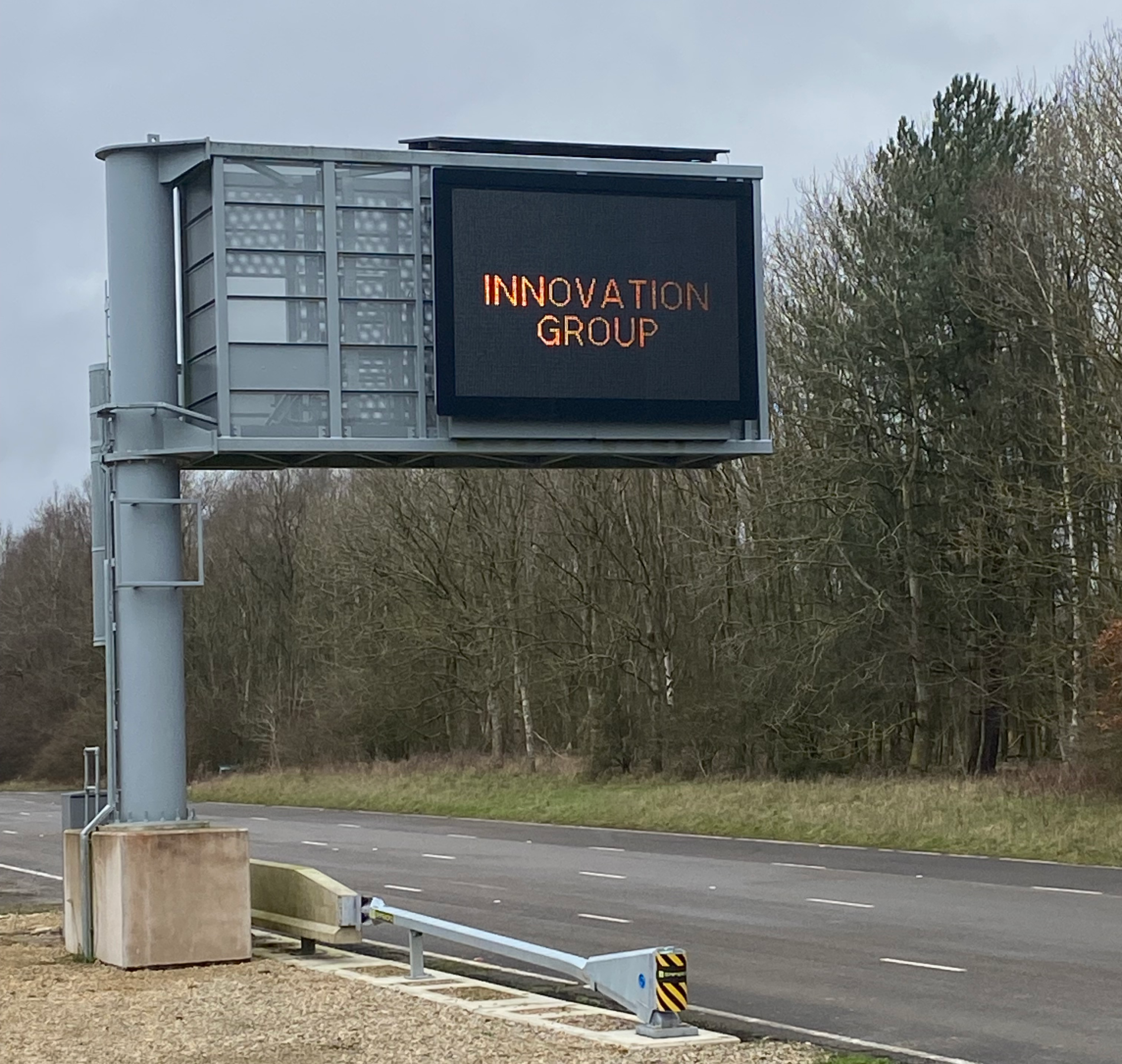
New Construction Technique. Standardised MS4
What lessons were learned?
Creating a standardised MS4 will establish design efficiencies and therefore some designers may feel in danger of losing future work.
Sustaining the innovation by maintaining awareness among potential users has proven difficult.
What does scaling mean here?
Obtaining change to standards and adding design to the digital product catalogue.
Making the design available for use on all relevant projects which require MS4s.
Scenario 2 - Better construction materials
To address stakeholder needs, a project was launched in 2019 to identify and test concrete repair products for the concrete roads programme. After market research, supplier engagement, and site trials, calcium sulphoaluminate (CSA) emerged as a productive solution and is now included in the material toolkit for use across the Strategic Road Network.

New Material. CSA (Calcium Sulphoaluminate)
What lessons were learned?
A departure from standards was required for this innovation; however, this was a very long process, as it was part of the new Manual of Contract Documents for Highway Works (MCHW) which took 2-3 years to be updated.
Sustaining the innovation by maintaining awareness among potential users has proved testing.
What does scaling mean here?
Material availability in the product toolkit as an option for designers and contractors.
Scenario 3 - Stop vehicle detection
With more motorways using the hard shoulder to improve traffic flow, new health and safety concerns arose, prompting research into stopped vehicle detection (SVD) technology in 2018. Following successful trials in 2019, radar-based systems have been deployed across Smart Motorways where the hard shoulder serves as a live lane, with installations completed by September 2022.

Operational technology. Stopped Vehicle Detection
What lessons were learned?
Transfer of roles and responsibilities as the idea matures can be challenging.
Lack of early commercial engagement has led to a monopoly with suppliers.
Expanded use of this innovation has been difficult, especially as the kit to implement was bespoke to the proprietor/owner, and therefore difficult to use in standards.
Unclear if benefits identified during the project life cycle, including reduced staffing levels, could be scaled to the network.
Tracking changes and developments in a rapidly advancing market is challenging.
What does scaling mean here?
Use of SVD across pre-existing and future smart motorway projects
Scenario 4 - Automatic cone laying
This 2018 innovation project focused on two automated cone laying machines (ACLM) developed by different manufacturers. In-depth research, iterative product building and development occurred in parallel to continuous engagement with industry wide experts.
The first prototype was developed in 2019 and the first trial on the Strategic Road Network (SRN) was conducted on the M4 and the West Midlands (Area 9) in 2020. With a production model now ready and available to use on the SRN, roller one was tested in early 2022.

Safety product and service. Automated Cone Laying Machine
What lessons were learned?
A machine of this kind is not readily available 'off the shelf', creating a lack of supply for use across the SRN and to demonstrate benefits.
Data/research documenting data related to specific risks associated with traffic management should have been conducted at the outset as part of the concept development; anecdotal risks 'known' among industry is not sufficient – a study assessing the risks was commissioned only after this project ran its course.
Effective IP agreements have been challenging.
Timely and effective engagement with the end stakeholder (Operations and Maintenance) to set a benchmark for operational integration was missing and is essential.
Higher cost of the product than current equipment, the efficiency and operational savings were not initially captured; and the lack of a forward programme for temporary traffic management contractors affecting further development and future adoption.
What does scaling mean here?
Adoption of the ACLM by large contractors/maintenance companies (i.e. companies working on large scale highways projects (<£10 million) with regular use of traffic management).
Scaling, and efficiency savings from scaling, become challenges without some commitment of volume which is reliant on transition into existing or future contract models
Missed opportunity to link the development of this technology to other innovations or established technologies to create a greater evolution of automation, (e.g. enhanced mobile carriageway closure).
