CONNECTING SAFER JOURNEYS

Take a look at our stimulus cards

Explore our diverse scenarios, providing a detailed look at suicide prevention. Including appropriate language, research, key messaging, and valuable insights.

Please click on each card to find out more.

How to use sensitive language

Click this card to find out more information.

Ask because you care

Click this card to find out more information.

Insights for impact

Click this card to find out more information.

Key findings
Connecting safer journeys

Click this card to find out more information.

Key themes

Theme 01

Collaboration

To be successful in suicide prevention, organisations need to work collaboratively, including by standardising data collection, management and analysis, and using insights to set forward-focused strategies.

Theme 02

Exploring technologies and digital innovations

Researching and trialling new technologies and innovations is one potential solution for improving suicide prevention efforts, while acknowledging that effective prevention requires a multi-layered approach.

Connecting Safer Journeys

A visual summary from National Highways and Digital Lab exploring suicide prevention, safer journeys, lived experience, data, insight and collaborative action.

Illustrated National Highways banner promoting kindness, checking in, talking to each other, breaking barriers and challenging stigma.
Supporting banner for the Connecting Safer Journeys visual summary.

Text version of the supporting banner

This banner highlights simple, human actions that support suicide prevention, compassion and open conversation.

  • Be kind and compassionate.
  • A problem shared is a problem halved.
  • Consider what is unspoken.
  • Ask: how are you doing, really?
  • Think about how you phrase important questions.
  • Take a moment to check in.
  • Break barriers.
  • Talk to each other.
  • Build community.
  • Challenge stigma.
  • Call it out.
  • You okay?
  • Reach out.
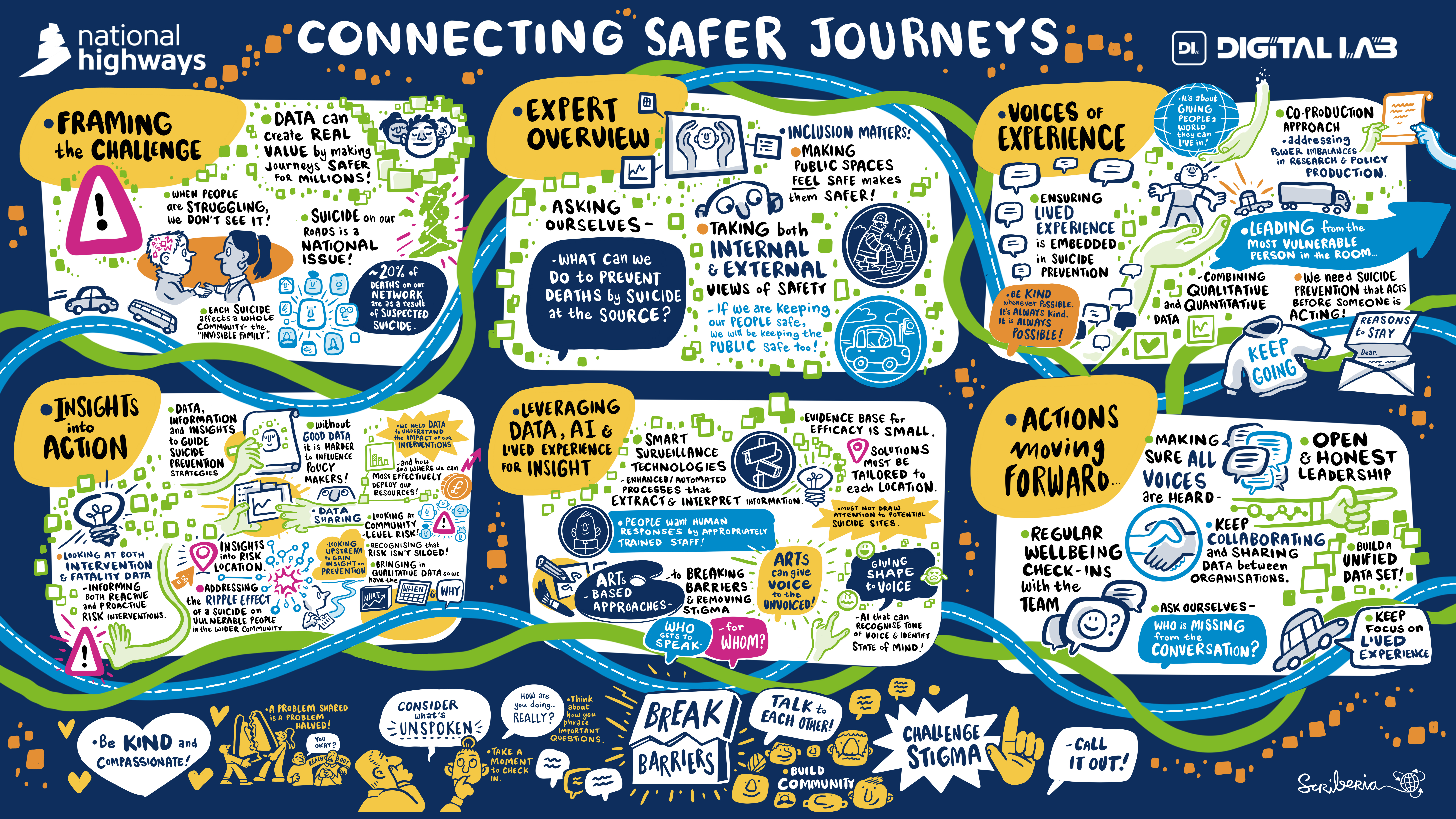
Illustrated National Highways visual summary titled Connecting Safer Journeys, showing key themes around suicide prevention, lived experience, data, safety, leadership and future actions.
Visual summary: Connecting Safer Journeys.

Text version of the visual summary

Framing the challenge

Data can create real value by making journeys safer for millions.

When people are struggling, we do not always see it.

Suicide on our roads is a national issue.

Each suicide affects a whole community — the “invisible family”.

Around 20% of deaths on our network are as a result of suspected suicide.

Expert overview

We need to ask ourselves: what can we do to prevent deaths by suicide at the source?

  • Inclusion matters.
  • Making public spaces feel safe makes them safer.
  • We need to take both internal and external views of safety.
  • If we are keeping our people safe, we will be keeping the public safe too.

Voices of experience

Lived experience must be embedded in suicide prevention.

  • Be kind whenever possible. It is always possible.
  • It is about giving people a world they can live in.
  • Use a co-production approach.
  • Address power imbalances in research and policy production.
  • Lead from the most vulnerable person in the room.
  • Combine qualitative and quantitative data.
  • We need suicide prevention that acts before someone is at crisis point.
  • Keep going.
  • Give people reasons to stay.

Insights into action

Data, information and insights should guide suicide prevention strategies.

  • Without good data, it is harder to influence policy makers.
  • We need data to understand the impact of our interventions.
  • We need to understand how and where we can most effectively deploy our resources.
  • Data sharing is essential.
  • Look at community-level risk.
  • Recognise that risk is not siloed.
  • Bring in qualitative data so we understand the what, when and why.
  • Look upstream to gain insight into prevention.
  • Use insights to understand risk location.
  • Address the ripple effect of suicide on vulnerable people in the wider community.
  • Look at both intervention data and fatality data.
  • Use data to inform both reactive and proactive risk interventions.

Leveraging data, AI and lived experience for insight

Data, AI and lived experience can help improve understanding, but they must be used carefully and responsibly.

  • Smart surveillance technologies can support enhanced and automated processes that extract and interpret information.
  • The evidence base for efficacy is small.
  • Solutions must be tailored to each location.
  • We must not draw attention to potential suicide sites.
  • People want human responses from appropriately trained staff.
  • Arts-based approaches can help break barriers and remove stigma.
  • Arts can give voice to the unvoiced.
  • Creative approaches can give shape to voice.
  • We should ask: who gets to speak, and for whom?
  • We should explore how to recognise tone of voice and identify state of mind.

Actions moving forward

  • Make sure all voices are heard.
  • Support open and honest leadership.
  • Hold regular wellbeing check-ins with the team.
  • Keep collaborating and sharing data between organisations.
  • Build a unified data set.
  • Ask ourselves: who is missing from the conversation?
  • Keep focused on lived experience.

Supporting messages

  • Be kind and compassionate.
  • A problem shared is a problem halved.
  • Consider what is unspoken.
  • Ask: how are you doing, really?
  • Think about how you phrase important questions.
  • Take a moment to check in.
  • Break barriers.
  • Talk to each other.
  • Build community.
  • Challenge stigma.
  • Call it out.

Expert articles

Dive into our articles to discover detailed discussions and thought leadership from our specialists.

Please click on each card to find out more.

Useful links

Samaritans

Every 10 seconds, Samaritans answers a call for help. Samaritans has thousands of volunteers from all walks of life who are there to listen without judgement.

Call 116 123 for free or visit: samaritans.org

The NSPA brings together individuals and organisations who care about suicide prevention. Their members take individual and collective action to reduce suicide and support those affected by suicide.

This guidance was produced in collaboration with Samaritans with the purpose of raising awareness of suicide prevention within road-user safety management.

Download the guidance

Shout is the UK's free, confidential text support service that operates 24/7.

Text 85258 or visit Giveusashout.org

Feedback