Red X
Have you
noticed the Red X
signal when driving on
motorways?
It’s there for your safety and it’s illegal to ignore it. You never know what's in the lane ahead.
The Red X signal is crucial for supporting your safety on motorways. It tells you when a lane is closed, helping any drivers and their passengers who may have got into difficulty. It also provides a safe place to work and incident access for the emergency services, recovery operators and our road workers.
Most drivers respect the Red X signal. But those who don’t put themselves and other road users at real risk.
What does a Red X mean?
A Red X means the lane is closed for an incident or hazard ahead, and must be kept clear. There may be a broken-down vehicle or debris ahead, or people working in that lane. Emergency services and traffic authorities also use closed lanes to reach incidents and help people in difficulty.
You must not drive in any lane that is closed with a Red X; it’s both dangerous and against the law to do so.
If you ignore a Red X, you could receive a fixed penalty of up to £100 and three points on your licence, and in some cases a court appearance which can lead to more severe penalties.
Observe the
Red X and
all other signals

The illustrations below show a typical sequence of signs and signals you’ll see on the motorway when a Red X signal is set. This helps to manage incidents or collisions.
For each stage, the first illustration shows how these appear on one of the larger signs mounted at the side of the motorway, displaying advice, restrictions and/or warnings for all lanes. The second illustration shows how the same advice, warnings and restrictions would appear on lane-specific overhead gantries.
It's against the law to drive in a lane to which the Red X applies, whether this is indicated for that lane on a single sign by the side of the motorway or by individual signs above each lane.
What to look for
1. Lane closure warning
A warning message will be displayed for a lane closure ahead. Obey any speed limits shown on this sign.


2. Lane change arrows
Move into the next available lane as indicated by the arrow. This signal may be repeated. If you're in an open lane next to a lane which is about to be closed, leave space to allow other drivers to move into the open lane safely.


3. Red X
You must not enter or continue in a lane closed by a Red X signal. This may be shown on a single sign by the side of the motorway, or on lane-specific signs on overhead gantries. Even if you've passed a hazard or obstruction, do not move into a lane marked with a Red X - there could be other dangers further ahead in the same lane.


4. Re-opening lanes
Signs will tell you when a lane has been re-opened and any speed restrictions removed, by showing either a variable speed limit, the national speed limit symbol, or the word ‘END’. A blank sign does not cancel a Red X.

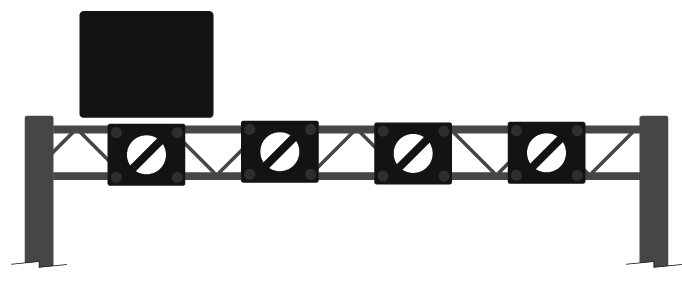
Sometimes a Red X signal needs to be set far in advance of an incident to provide access for emergency services. Or to help drivers re-join the motorway from an emergency area. When you see the Red X, it means the lane is closed and you must not use it.
Please leave gaps in the traffic to let other drivers move into an open lane.
Signals will also show when the lane is re-opened. You may see a national or variable speed limit, or a message informing you of the end of the restriction. Do not move into a closed lane even if you’ve passed a hazard, as there may be other hazards up ahead in the same lane.
Remember, it’s illegal and dangerous to drive in a Red X lane. If you’re caught, you could receive a fixed penalty of up to £100 and three points on your driving licence. More serious cases may be referred to the courts, where higher penalties can apply.
