Step 1: Plan your strategy
The first step is to plan your strategy - decide what you need to build and where.
What types of EV are there?

EV type: BEV
Definition
Battery electric vehicle
Drivetrain
Electric motor
Power source
Batteries charged from charge point

EV type: HEV
Definition
Hybrid electric vehicle
Drivetrain
Internal combustion engine (ICE) and electric motor
Power source
Liquid fuel powers the ICE. ICE is also used to recharge the batteries

EV type: PHEV
Definition
Plug-in hybrid electric vehicle
Drivetrain
ICE and electric motor
Power source
Batteries charged from charge point. Liquid fuel also required.
Types of EV charging
EV charging infrastructure is the equipment and systems that supply electricity to charge EVs. EV charging infrastructure comes in different forms, depending on how fast vehicles need to charge and where charging takes place.
Slower chargers are typically used for vehicles parked for long periods at home or at work. Faster chargers are installed for public use where drivers need to recharge quickly before continuing their journey, such as at roadside facilities. The types of charging used on the strategic road network are shown in the following table.
| Charger type | Where | Power | Use | Rate of charge | Best for |
|---|---|---|---|---|---|
| Rapid charging | Motorway services, EV hubs | 50-149kW | Quick top-ups on long journeys | 90-250 miles in 30 minutes | Long-distance trips, fleets |
| Ultra-rapid charging | Motorway services, EV hubs | 150kW+ | Quick top-ups on long journeys | 250+ miles in 30 minutes | Long-distance trips, fleets |
Alternating current and direct current
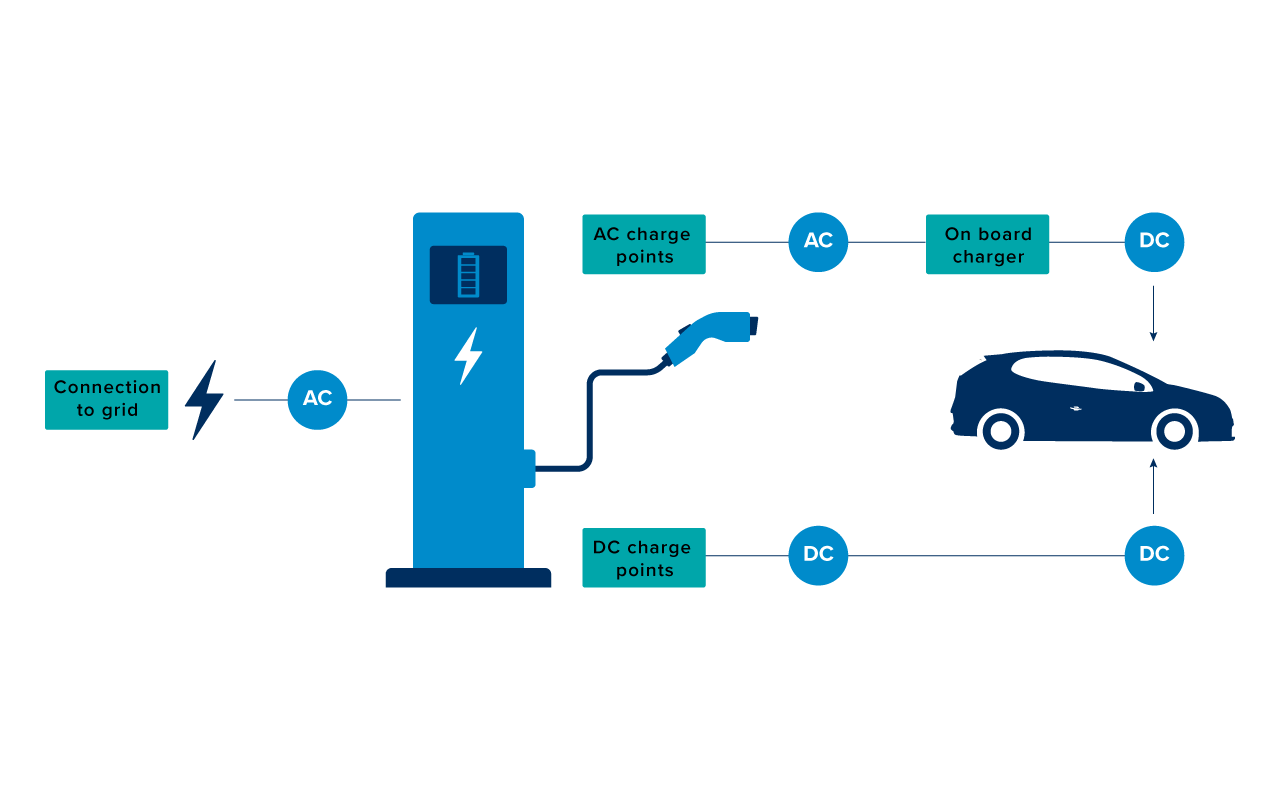
When thinking about charge points at your site, you’ll hear about direct current (DC) and alternating current (AC) as two forms of electrical current. The grid delivers AC, but batteries store DC. Because EVs use batteries, chargers convert AC to DC, either in the charge point (rapid or ultra-rapid chargers) or in the car (for slower chargers).
The diagram below shows this conversion of AC from the grid to DC in the vehicle for both types of charge point.
Understanding demand
Electricity supply is critical to EV charging. The following steps set out how you can understand how much electrical capacity you have now and what you'll need at your site to cater for future demand.
1) Check existing capacity
Find out who your distribution network operator (DNO) is - the Energy Networks Association has a tool (Transport Connections Guidance) that can guide you through the process just by inputting your postcode.
Find out what your DNO currently supplies – this is called your agreed supply capacity (ASC). It’s measured in kilo-volt amperes (kVA).
2) Work out how much electricity you'll need
While there isn’t a simple calculator to work out how to forecast future electricity demand, there are a few indicators that can indicate how demand can be forecasted. These include:
- number of parking spaces
- how long people stay in the car park to charge their vehicle (dwell time)
Once you have an idea about what you'd like to offer, the DNO can help you to determine upgrade costs for new or upgraded grid connections to support EV chargers.
You can get further information from DNOs and independent distribution network operators, for example through heatmaps, connection surgeries, budget estimates or feasibility studies.
Understanding the cost and build out timetable for upgraded electrical connections, along with the consents and approvals you’ll need prior to making a new connection request (and order) will help you plan your investments.
3) Increase site power if forecast demand exceeds existing supply
Make the connection request to your DNO. Early engagement is critical for you through the application and connection process.
The time to upgrade a grid connection to a site can vary and be a challenge for many site operators. However, we expect these to reduce over time because of Government reforms to the connections process.
More detail about this can be found on Step 3: Detailed design, grid connection and pre-construction.
