Material Change Consultation
Have your say on proposed changes to the Lower Thames Crossing
Share this article
National Highways is consulting on proposed changes to the Development Consent Order (DCO) for the A122 Lower Thames Crossing.
The proposed changes relate to measures associated with the protection of the Epping Forest Special Area of Conservation (SAC). The changes would not affect the route of the Lower Thames Crossing or its main elements, including the road, junctions or tunnel.
We are seeking feedback from anyone who may have an interest in the proposals.
The consultation runs from Tuesday 30 June 2026 to Tuesday 28 July 2026.
About the proposed changes
The changes that we are considering would not alter the route of the A122 Lower Thames Crossing or affect its main elements, including the road, junctions, tunnel or other significant infrastructure.
When development consent for the Lower Thames Crossing was granted, requirements were included to reduce potential impacts on the Epping Forest SAC from vehicle emissions associated with traffic using the new road.
To reduce these impacts, the DCO included:
- a temporary reduction in the speed limit from 70mph to 60mph on the westbound carriageway of the M25 between junctions 26 and 27
- monitoring of nitrogen and other air pollutants in this area.
Recent research conducted by National Highways elsewhere on the strategic road network concluded there was no clear and discernible evidence to demonstrate a link between a reduced speed limit from the national speed limit to 60mph and improved roadside air quality.
National Highways is therefore considering whether there is a case for providing compensatory habitats instead of introducing the speed limit reduction.
We are considering applying for a change to the DCO that would:
- remove the requirement to implement a speed limit reduction on the M25 between junctions 26 and 27
- remove the requirement to monitor nitrogen and other air pollutants in this area
- replace these measures with new compensatory habitats near the M25 and Epping Forest SAC
- update the project’s environmental assessments to support the proposed changes.
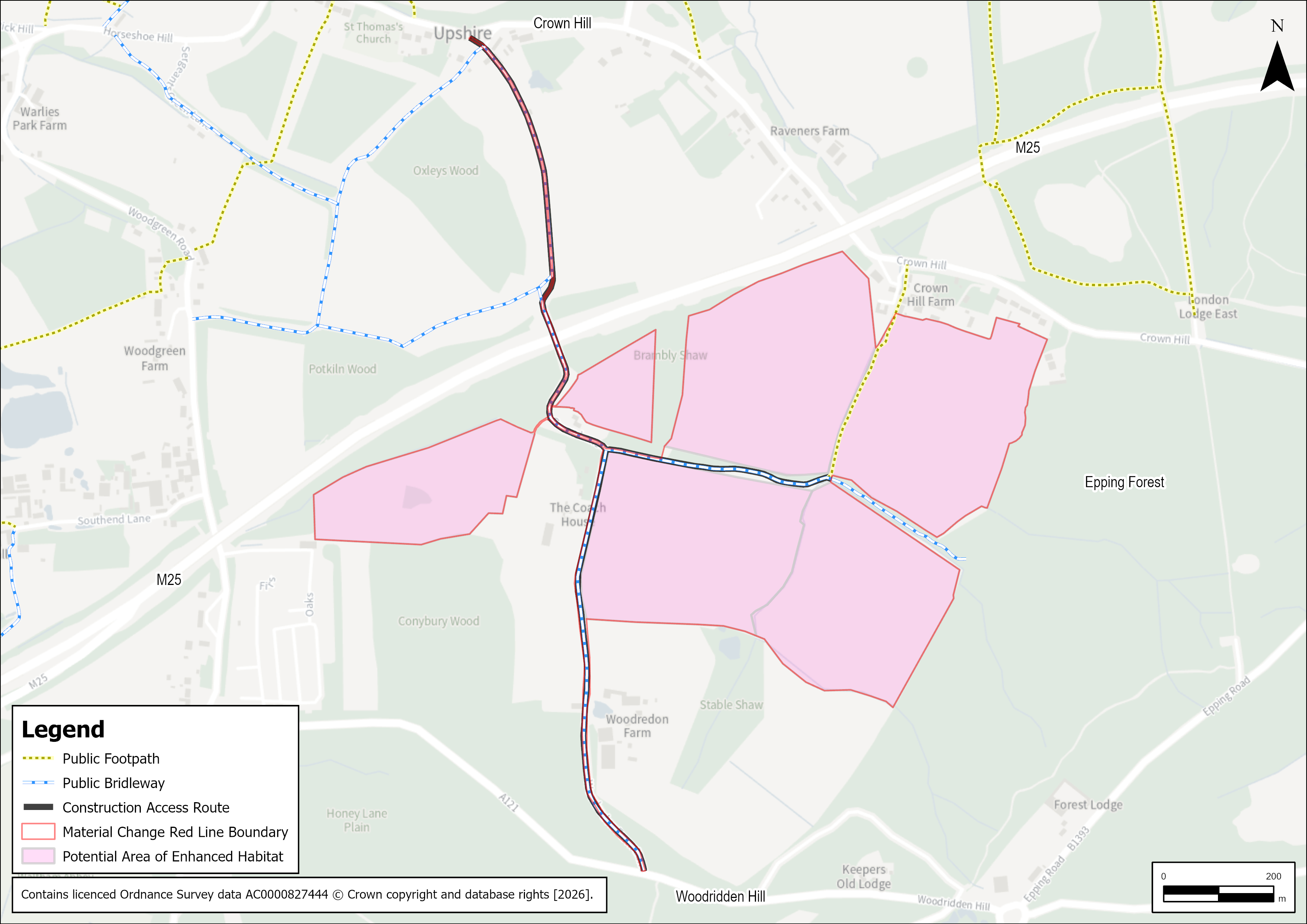
To deliver this change, we would acquire an interest in agricultural land (as shown on Figure 1 below) between the M25 and Epping Forest SAC and enhance the habitat on that land. The establishment of new trees and shrubs would compensate for the impacts from vehicle emissions identified in the original DCO application in relation to Epping Forest SAC.
The proposed changes relate only to these specific requirements and would not alter the approved route, tunnel, junctions or other significant infrastructure associated with the Lower Thames Crossing.
What we’re consulting on
We’re inviting feedback on:
- The proposed acquisition of an interest in agricultural land by the Project and the creation of enhanced ecological habitats
- Removal of the requirement for a reduced speed limit on the M25 between junctions 26 and 27
- Removal of the requirement to monitor nitrogen and other air pollutants in this area
- Local environmental and community effects from the creation of enhanced ecological habitats
We’re not consulting on:
- Other aspects of the Lower Thames Crossing
- Other National Highways projects or roads.
Consultation materials
The following documents are available to download:
How to have your say
Online
The easiest way to give us your views is by completing the online response form here.
By post
Download and print a paper response form here or respond by letter.
The downloaded response form can be submitted by post to:
Material Change Consultation
Lower Thames Crossing
Pilgrims Lane
Chafford Hundred
RM16 5UZ.
Email
You can also email the downloaded response form to:
consultationresponses@lowerthamescrossing.co.uk
Find out more
You can contact us to find out more about the proposals or to request a printed consultation brochure, response form or materials in an alternative format, free of change (one per household).
Email
info@lowerthamescrossing.co.uk
Phone
0300 123 5000
Consultation dates
The consultation opens on Tuesday 30 June 2026 and closes on Tuesday 28 July 2026.
The deadline for submitting your feedback is 11.59pm on Tuesday 28 July 2026.
We cannot guarantee that consultation feedback submitted by any other method, or received after this deadline, will be considered.